When the core product changes, what should a company keep?
TEISA: taking technical capabilities and customer understanding into the next business
TEISA
A business study based on public sources. Company explanations and interview statements are distinguished from our interpretation.
Sources reviewed: 2 November 2026Before reading about TEISA
A product that sells well today may not enjoy the same demand a few years from now. What will the company have left? Alongside equipment and brands, it may retain an understanding of customers' work, the ability to solve problems and the capacity to learn.
Paraguay's TEISA has roots in selling and servicing electric typewriters. Today its offerings include business connectivity and cloud services.[S01][S02][S04][S05] This feature uses that evolution to examine three questions: which capabilities can carry over, which skills must be learned and what work continues after the sale.
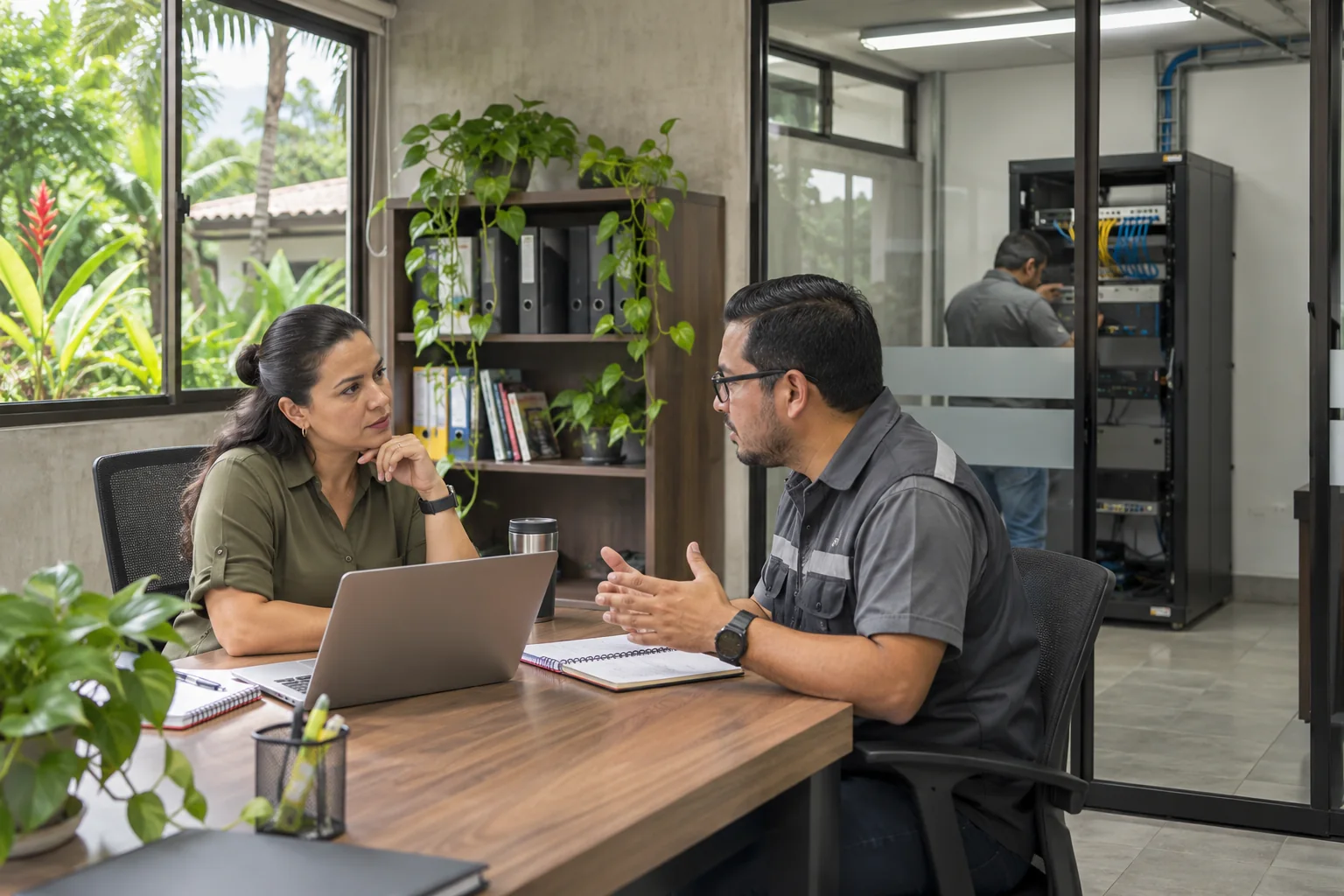
Office work and technical support belong in the same conversation. AI-generated illustration. Fictional people and equipment; not a photograph of TEISA.
The first product supported office work
TEISA's official profile dates its founding by Jaime Egüez to 1987.[S01] A 2022 management interview describes Jaime and Manuel Gómez establishing its predecessor, TEI SRL, to sell and provide technical services for IBM Composer electric typewriters.[S02]
There were two jobs: selling a machine and helping keep it usable. The sources reviewed do not establish the amount or source of the initial capital. The start of the business and its later incorporation as a sociedad anónima should also be treated as separate events.

A general period-office illustration, not a specific model or a reconstruction of the founding premises. AI-generated illustration. Fictional people and equipment; not a photograph of TEISA.
Our interpretation Sales and maintenance can reveal more than product specifications: they show where customers run into difficulty. Is the problem how the equipment is used, a fault, or a mismatch with the way the work is organised? Experience in distinguishing those causes may remain useful when the product changes.

Understanding customers' work can remain useful when equipment changes. AI-generated illustration. Fictional people and equipment; not a photograph of TEISA.
We have not established that the customers of that period kept their contracts through to the present. The focus here is the ability to understand customers' work, rather than proven continuity of a customer list.
The next opportunity emerges as customers' work changes
In the 2022 interview, Galo Egüez, then chairman, describes identifying demand for links between headquarters and other offices after attending a communications technology fair and conducting market research. The same article names Citibank among the company's early private-sector customers.[S02]
Both the official company profile and a 2025 interview with the founder describe work during the 1990s on a fibre-optic networknote 1 connecting public institutions.[S01][S03] The sources use different years for the start, installation and handover. We therefore do not establish a detailed sequence here.
Our interpretation A typewriter and a communications link look like very different products. From the customer's perspective, however, both are tools for handling information. When work no longer ends where a document is prepared, but requires information to be shared with other locations, the support needed also changes.

The focus moves from equipment to how work is coordinated. AI-generated illustration. Fictional people and equipment; not a photograph of TEISA.
Finding a new technology is not enough to create a business. It helps to identify whose work is being held up, which task is affected and where the problem occurs. A slow connection and duplicate data entry are different problems, with different solutions and budgets.
International companies seeking new customers can apply the same sequence. Before presenting a product, understand the practical difficulty and who decides how to address it. Beyond technical novelty, consider whether the buyer can explain what will improve in the work.
In the following chapters
The following chapters examine how to learn new technologies, fulfil responsibilities after installation, prepare equipment and people, and start with a small trial. Register for free and confirm your email to return here and read all six chapters.
- Using experience also means learning again
- The work continues after installation
- Demand does not remove the need to fund equipment and people first
- The next technology can also start with one customer problem
Term notes
Fibre-optic network
A network of cables that transmit information using light, together with their connecting equipment. It enables information to be exchanged between buildings or locations.
Back to the text ↑
Sources consulted
This company study draws on public sources; it is not based on an interview conducted by PARAGUAY INSIGHT. Company history and services are attributed to the company, and interview views to their speakers. Applications to management are separated under “Our interpretation”. Sources differ on founding, incorporation and the dates of the early network. Details that have not been reconciled are not presented as settled. Specific failures, losses and the profitability of each activity have not been verified either. Sources checked on 2 November 2026. Undated official pages are treated as descriptions of the offering visible on that date.
- S01 TEISA, “Nosotros” ↗
(no publication date displayed)
Company history, founding year and the network for public institutions. - S02 Club de Ejecutivos del Paraguay, “Teisa celebra 35 años” ↗
(25 May 2022)
Interview with Galo Egüez on the predecessor business, first product, demand and expansion. An account centred on the executive's recollections. - S03 ABC Color, “Teisa: Casi cuatro décadas desafiando los límites de la tecnología” ↗
(28 May 2025, David Chamorro)
The founder's training and approach to technical knowledge. A business profile in the Negocios section, not an independent audit of performance. The quotation in this edition is translated from Spanish by this publication. - S04 TEISA, “Internet y enlaces de datos” ↗
(no publication date displayed)
Business connectivity, monitoring, support and service conditions. - S05 TEISA, “Cloud” ↗
(no publication date displayed)
Virtual servers, backups and monthly service offerings. - S06 TEISA, “Data center” ↗
(no publication date displayed)
Equipment housing and its infrastructure and operating environment. - S07 TEISA, “IoT” ↗
(no publication date displayed)
Sensor uses and expansion from a small trial.