When a trading companyopens a factory
The journey of CHACOMER’s founder and the management methods later generations reconsidered
CHACOMER
A feature based on public sources. We distinguish historical accounts, company explanations, executives’ published statements, rating-agency assessments and our analysis.
Sources reviewed: 17 November 2026Before reading about CHACOMER
Company histories often highlight the year a business was founded or a factory opened. Before those milestones, someone spent time studying and working.
Historical accounts of CHACOMER founder Kornelius Walde, together with explanations from later executives, help us explore the connection between that experience and the business. This article focuses on Chacomer S.A.E. Where a source discusses management of the wider group, we indicate that scope.

Moving from selling to assembly and quality checks brings different responsibilities and skills. AI-generated illustration. It is not a photograph of actual CHACOMER people, facilities or events.
What experience did the work before the company’s foundation provide? What did the next generation change? How should we assess a decision that protected supply but increased costs? These three questions can also help readers think about their own work.
We distinguish documented events in people’s lives from the lessons PARAGUAY INSIGHT draws from them.
Before the business, there was study and work
According to Alfred Neufeld’s entry in the Mennonite history dictionary Menonitica, Walde was born in Russia in 1916 and arrived in the Chaco in 1932 with a migrant group that had travelled via Harbin. He was still a teenager. The account says he completed his schooling in Fernheim and then moved to Asunción to continue studying.[S09]
A 2019 educational publication from Cooperativa Alemán Concordia also names him among the early students who went to the capital. It describes inadequate living conditions for that group and assistance from families already settled there to people arriving later.[S10]
Menonitica records work managing a student residence, employment with the Mennonite Central Committee (MCC), and responsibility for the Fernheim cooperative’s commercial office in the capital. These roles preceded the company’s foundation in 1956.[S09]

Learning and work experience can inform the next step. This image does not recreate the founder’s student years. AI-generated illustration. It is not a photograph of actual CHACOMER people, facilities or events.
Our interpretation This background shows why earlier work deserves attention. Supporting people’s everyday needs and handling goods call for different abilities. A reader preparing to start a business can list previous responsibilities and distinguish the capabilities they already have from those they still need to develop.
From the first products to a factory of its own
The company’s official history says it began in 1956 by importing and selling brushes, bicycle parts and hardware, among other goods. Its range later expanded: Kenton motorcycles were introduced in 1994, followed by a factory in Fernando de la Mora in 2002.[S01]
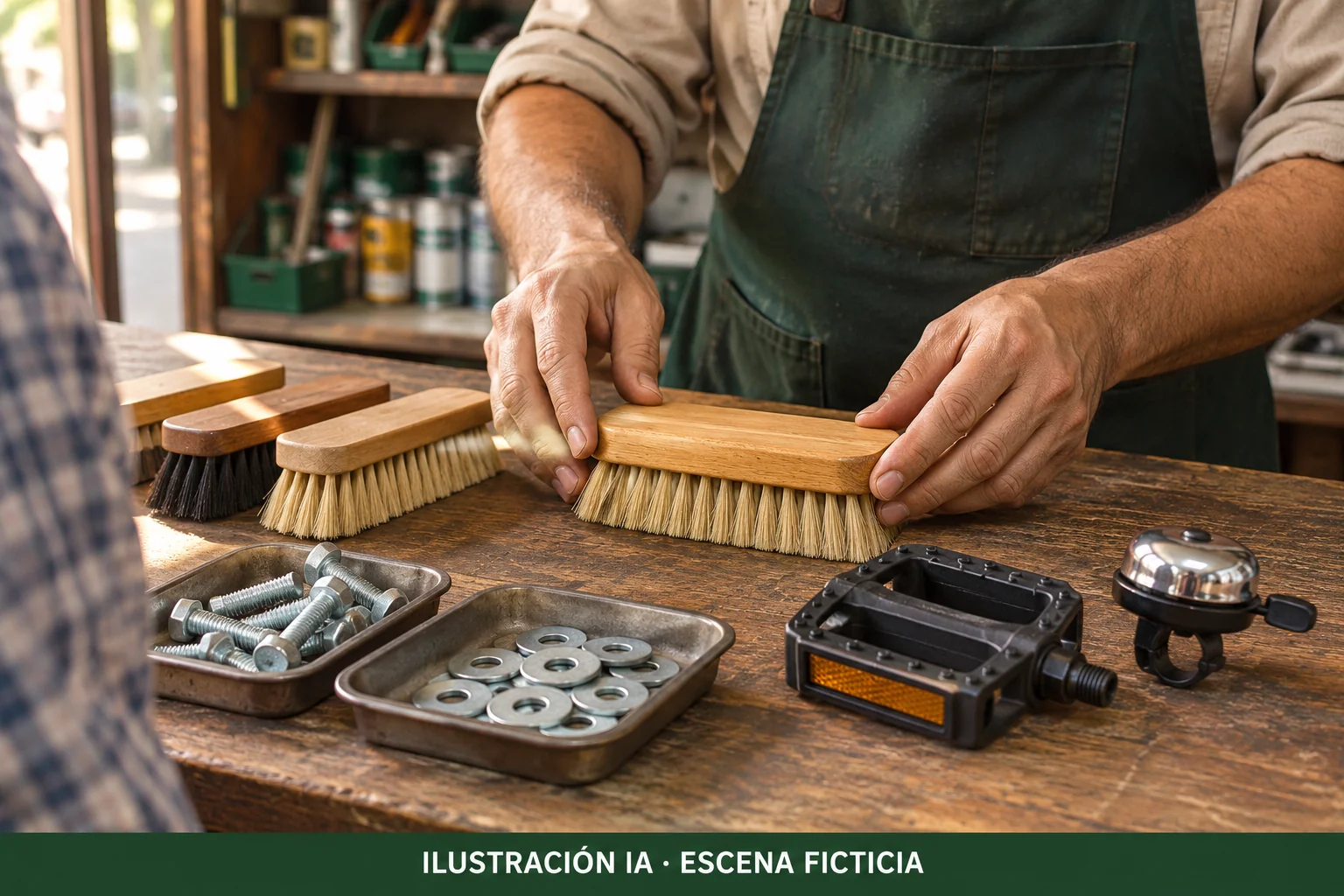
Handling products can also build knowledge of their uses and replacement parts. This is not a reconstruction of the original shop. AI-generated illustration. It is not a photograph of actual CHACOMER people, facilities or events.
Feller Rate’s assessment dated 9 March 2012 describes tax benefits for manufacturing in Paraguay as an advantage over importing finished products.[S12] This is a later assessment, not a record of the 2002 investment decision.
This sequence provides a starting point for thinking about trade and production. Buying finished goods to sell requires different equipment and skills from assembling them and checking their quality. Sales experience alone does not mean a business is ready to manufacture.
Our interpretation Knowing what sells, which faults occur and which spare parts customers need can inform a new business. However, the history we reviewed does not identify which information was decisive in CHACOMER’s investment in a factory.
Our interpretation An industrial investment requires examining sales prospects, cost differences linked to the regulatory framework and the burden if those conditions change. This is a way to analyse decisions, not a reconstruction of CHACOMER’s investment approval.
In the following chapters
The following chapters examine assembly responsibilities, company-wide planning, inventory and capital, after-sales support and succession. Register for free and confirm your email to return here and read all seven chapters.
- Domestic assembly brings new responsibilities
- From departmental plans to a company-wide plan
- Inventory protects operations, at a cost
- The business includes promises made after the sale
- Passing on a business means rethinking how decisions are made
Term notes
Sources consulted
Pre-founding experience and family information come from historical accounts. Company histories and reports present the company’s explanation. FDC’s publication also reflects its position as a management-support provider. Rating reports reflect the agency’s assessment at each date. Forecasts are not presented as realised results. This feature covers published accounts of people’s backgrounds and management decisions. We do not fill gaps in the sources with assumptions about motives, household finances, feelings or investment details. FDC’s published statements were checked against indexed official text, but the original PDF pages could not be inspected. The questions and hypothetical examples are our prompts for readers to consider their own work.
- S01 Grupo Chacomer, Chacomer SAE ↗
Update date not stated; checked 17 November 2026
Company account of its founding, product range and factory opening. - S02 FIX SCR, Chacomer S.A.E. Informe de Calificación ↗
7 October 2026; pp.2-3
Assembly with imported components and customer credit. BCP hosts the document; FIX SCR is the evaluator. - S03 Fundação Dom Cabral, Abre aspas, CHACOMER chapter ↗
Published in 2018; chapter pp.105-111
Family relationships and management context. Published statements checked against indexed official text; original PDF pages not inspected. An apparent discrepancy between the PCS start date and elapsed time in a quotation means no start year is specified. A provider’s case that also covers the group. Statement date unconfirmed. - S04 FIX SCR, publication on Chacomer S.A.E. ↗
12 October 2023
Inventory and costs in 2021; EBITDA decline in 2022. Rating-agency account. - S05 FIX SCR, Chacomer S.A.E. Informe de Calificación ↗
10 October 2024; p.1
Year-on-year EBITDA increase in 2023, without implying a full return to the earlier level. Forecasts and results are distinguished. - S06 CHACOMER, Servicio Técnico ↗
Update date not stated; checked 17 November 2026
Published bicycle maintenance services. Not an assessment of actual service performance. - S07 CHACOMER, Cambios y devoluciones ↗
Update date not stated; checked 17 November 2026
Product-specific warranty conditions. Description of terms, not an assessment of their legal validity. - S08 CHACOMER, Prospecto de Programa de Emisión Global de Bonos G7 ↗
June 2025; pp.19-20
Issuer information on directors’ responsibilities and education. Does not establish all current positions in 2026. - S09 Alfred Neufeld, Walde, Kornelius, Menonitica ↗
Update date not stated; checked 17 November 2026
Historical dictionary covering migration, education, earlier work and family. Neither the founder’s memoir nor primary civil records. - S10 Cooperativa Alemán Concordia, Material Educativo ↗
First edition, 2019; p.19
Names Walde among early students and describes community circumstances. Text and page inspected. Does not document his personal finances or feelings. - S11 CHACOMER, Memoria del Directorio, Ejercicio 2023 ↗
2023 financial year; displayed electronic signature dated 26 March 2024; pp.5-6
Memoria CHACOMER 2023.pdf in the Balance de Diciembre de 2023 ZIP. Text and pages inspected. Effects, costs and expectations are distinguished. The quotation is translated from Spanish. - S12 Feller Rate, Acta de la sesión de calificación Nº 007, CHACOMER section ↗
9 March 2012; PDF pp.17-18 (folios 0172-0173)
Assessment of competitive conditions at that time. Text of the PDF hosted by BCP checked. It does not establish the reason for the 2002 investment or current tax rules.